Why Don't Men Wear Engagement Rings: A Complete Guide
The landscape of masculine aesthetics is undergoing a profound transformation. For generations, the concept of commitment jewelry was completely asymmetrical. The modern gentleman is now questioning these boundaries, leading to a resurgence of interest in male engagement bands. To master this evolving category of accessories, one must look beyond basic retail advice and understand the deep interplay of metallurgy, anatomy, and architectural design. Whether you are actively seeking a commitment piece or simply building your foundational knowledge through our complete men's jewelry guide, recognizing the history and mechanics of these pieces is absolutely essential.
Introduction to Male Engagement Rings
Male engagement rings represent a conscious shift toward mutual partnership and elevated personal styling. They bridge the gap between traditional relationship markers and contemporary masculine expression.
Historically, fine jewelry for men was strictly utilitarian or served as a marker of dynastic power. The concept of wearing a ring specifically to denote an impending marriage was entirely absent from the masculine wardrobe for centuries. Today, the modern man views jewelry not as a mere afterthought, but as an essential component of a curated aesthetic. The rise of the male engagement piece is a testament to this evolution. At ATLAS, we recognize that this shift requires a new vocabulary of design.
The modern aesthetic demands precision. A man selecting an engagement ring today is looking for structural integrity, sophisticated finishes, and optimal proportions. The piece must effortlessly integrate with his existing wardrobe, complementing his luxury timepieces and other metallic accessories. This is not about adopting feminine traditions. It is about forging an entirely new standard of masculine commitment jewelry that projects confidence, permanence, and uncompromising quality.

Why It Matters to Understand Engagement Ring Traditions
Understanding these traditions matters because it reveals how economic history shaped modern accessory habits. Tracing this lineage allows the modern man to make intentional styling choices rather than blindly following outdated societal norms.
To fully grasp the current landscape, one must look deep into antiquity. The original intent behind betrothal jewelry had very little to do with romance. It was fundamentally an economic contract. By studying these origins, you gain absolute clarity on why masculine jewelry developed on a completely different trajectory. You can read more about the broad evolution of these pieces on the engagement ring historical archives.
To fully grasp the current landscape, one must look deep into antiquity.
The history of men not wearing engagement rings
The history of men not wearing engagement rings dates back to ancient Rome. Roman law utilized rings made of iron, and later gold, to signify a binding legal agreement between families. The man presented the ring to the woman as a symbol that a financial transaction or dowry arrangement was secure. Because the man was the initiator of the contract, there was no societal requirement for him to wear a reciprocal marker. His word and his legal standing in the community served as his guarantee. This systemic asymmetry established a visual standard that persisted for thousands of years.
During the Middle Ages and the Renaissance, jewelry became heavily associated with royal courts and extreme wealth. Even then, betrothal bands remained exclusively on the hands of women. While men wore signet rings to seal documents or showcase family crests, these were tools of power rather than symbols of romantic commitment. The function of masculine jewelry was public authority. The function of feminine jewelry, in this specific context, was marital status. This absolute division is the historical foundation of the dual standard we see today.
Unpacking exactly why only women get engagement rings traditionally
When asking why only women get engagement rings traditionally, the answer lies in the twentieth century marketing landscape. The diamond industry heavily engineered the modern expectation of the diamond engagement ring. Massive advertising campaigns cemented the idea that a man must spend a specific portion of his salary on a stone to prove his worth and devotion. The entire narrative was constructed around male provision and female reception.
This dynamic inherently excluded men from being the recipients of commitment jewelry. The ring was framed as a gift that secured a future, effectively rendering the concept of a reciprocal male ring commercially unviable at the time. Men were positioned strictly as the buyers, not the wearers. This cultural conditioning was so powerful that it normalized the absence of male engagement rings across almost all Western cultures. Only recently have we begun to see a significant divergence from this highly commercialized mid century standard.
What You Need to Know About Modern Ring Selection
Modern ring selection requires a rigorous analysis of metal density, profile architecture, and daily wearability. A successful piece must balance structural resilience with visual refinement.
Choosing a premium engagement band is a technical process. You are selecting a piece of micro architecture that will undergo constant friction, impact, and elemental exposure. The materials you choose dictate the longevity and the developing character of the ring. Men generally interact with their environment with higher impact forces, requiring a distinct approach to metallurgical selection. To explore expertly engineered options, view our authoritative Men's Rings collection.
Metals behave differently over time. Some develop a coveted microscopic wear pattern known as a patina, while others remain entirely unchanged. Understanding these properties ensures your investment aligns perfectly with your lifestyle.
| Metal Type | Density & Weight | Durability Profile | Aging Characteristics |
|---|---|---|---|
| Platinum (950) | Extremely high weight | Highly malleable, absorbs impact without losing mass | Develops a frosted patina over time, highly desirable |
| 18k Solid Gold | Substantial weight | Moderate hardness, requires mindful daily wear | Maintains rich color, acquires subtle micro abrasions |
| Grade 5 Titanium | Ultra lightweight | Extremely high tensile strength, highly scratch resistant | Remains visually static, does not patina significantly |
| Tungsten Carbide | Heavyweight | Supreme scratch resistance, but structurally brittle | Maintains permanent factory finish, cannot be resized |
The width of the band is equally critical. Masculine hands typically require a wider profile to maintain visual balance. A band that is too narrow will look disproportionate, while one that is excessively wide may restrict knuckle articulation. Precision in sizing and width selection is the hallmark of sophisticated styling.

 Versla úr leiðarvísinum
The Cubic Zirconia Band Ring in Stainless Steel
11,419 kr
Versla núna →
Versla úr leiðarvísinum
The Cubic Zirconia Band Ring in Stainless Steel
11,419 kr
Versla núna →
Step by Step Navigating Masculine Commitment
Navigating masculine commitment jewelry requires an analytical approach to sizing, aesthetic alignment, and lifestyle integration. Following a structured methodology ensures the final piece performs flawlessly.
The process of acquiring a male engagement ring should be methodical. Treat it with the same rigorous attention to detail you would apply to commissioning a bespoke suit or selecting a mechanical timepiece. Precision in the early stages prevents significant styling and mechanical failures later.
Treat it with the same rigorous attention to detail you would apply to commissioning a bespoke suit or selecting a mechanical timepiece.
Changing traditions mens engagement rings
The changing traditions mens engagement rings present today require men to build a complete accessory strategy. Here is the definitive methodology for selecting and integrating a commitment band:
- Evaluate your existing hardware. Audit the metals currently featured on your watches, belt buckles, and briefcases to determine your primary metallic tone.
- Determine your exact knuckle and base finger diameter. Masculine knuckles are often significantly wider than the base of the finger, necessitating a sizing strategy that accommodates both zones.
- Select your interior profile geometry. Opt for a convex interior curve to reduce skin contact and friction, which is vital for daily wear comfort.
- Analyze your daily impact levels. Choose platinum or 18k gold for sophisticated office environments, and lean toward titanium if your hands face heavy mechanical stress.
- Define the exterior finish. Decide between a high polish for maximum reflection or a directional brushed finish to mute the visual output and disguise daily wear.
- Coordinate with secondary jewelry. Ensure the ring visually balances with other pieces you wear daily, maintaining a cohesive aesthetic across your entire presentation.
This structured approach removes the guesswork from jewelry selection. By treating the engagement ring as a primary foundational piece, you create a standard for the rest of your accessories. For instance, just as you carefully select subtle facial framing elements from our Men's Earrings collection to complete a look, your ring must integrate seamlessly into your overall style architecture.
Professional Tips for Adopting the Male Engagement Ring
Adopting a male engagement ring successfully demands strategic coordination with luxury timepieces and careful attention to structural proportions. The goal is an integrated, powerful visual presentation.
Mastering masculine jewelry requires an understanding of visual weight. When placing a significant piece of metal on your hand, you alter the focal point of your lower arm. If you wear a heavy mechanical dive watch on your left wrist, a substantial ring on your left ring finger creates a powerful, anchored aesthetic. However, if your ring is too fragile, the watch will overpower it completely. Balance is everything.
Consider the concept of metal mixing. While traditional rules dictate matching all metals perfectly, modern style allows for intentional contrast. A brushed titanium ring can pair exceptionally well with a stainless steel watch, provided the finishes share a similar industrial quality. If you wear a gold dress watch, an 18k gold engagement ring provides undeniable cohesion. For deeper insights into balancing these elements, consult our journal on ring styling.
Skin undertones dictate metal selection. Men with cooler, pink or blue undertones look exceptionally sharp in white metals like platinum or white gold. Men with warmer, olive or golden undertones find that yellow gold or rose gold heavily enhances their skin depth. Ignoring your natural complexion can result in the jewelry looking detached or excessively jarring.
Do not underestimate the power of edge detailing. A standard dome ring offers a classic silhouette, but a ring with step edges or a beveled cut introduces architectural complexity. These sharp, precision milled angles catch the light differently than rounded surfaces, projecting a highly engineered, modern masculinity. This subtle geometry is what separates premium execution from basic retail offerings.

Common Mistakes When Selecting Masculine Commitment Jewelry
The most common mistakes include ignoring the anatomical difference between the knuckle and the finger base, resulting in poor fit and discomfort. Overlooking the reality of metal degradation is another critical error.
A frequent failure in male ring selection is choosing an incorrect width. Many men default to a narrow band, assuming it will be less obtrusive. On a larger hand, a narrow band looks disproportionate and physically pinches the skin. Conversely, choosing an excessively wide band, such as a ten millimeter width on a short finger, severely restricts joint movement. The sweet spot for most masculine hands sits precisely between six and eight millimeters.
A frequent failure in male ring selection is choosing an incorrect width.
Another major mistake is ignoring the long term properties of the metal. Tungsten is highly popular due to its scratch resistance. However, tungsten is completely unyielding. It cannot be resized. If your finger size fluctuates due to weight changes, climate variation, or age, a tungsten ring will eventually become obsolete. Furthermore, in an emergency trauma situation, tungsten cannot be cut off conventionally, it must be shattered. Understanding these mechanical limitations is crucial.
Men often fail to account for the interior fit of the band. A standard flat interior maximizes surface contact with the skin. During hot weather or physical exertion, the finger swells, trapping moisture and causing significant discomfort. A premium piece of jewelry will always feature specialized interior geometry to mitigate this issue. For advice on placement protocols, review our article on which finger men wear their rings.
Finally, there is a tendency to overcomplicate the design. Incorporating multiple conflicting metals, excessive stone settings, and overly complex engravings dilutes the masculine impact of the piece. True luxury is defined by restraint. A single, solid piece of flawlessly finished platinum speaks volumes more than a busy, overdesigned accessory.
 Versla úr leiðarvísinum
The Black and Gold-Tone Groove Ring in Tungsten Carbide
12,089 kr
Versla núna →
Versla úr leiðarvísinum
The Black and Gold-Tone Groove Ring in Tungsten Carbide
12,089 kr
Versla núna →
The Definitive Style Guide for Masculine Rings
A definitive masculine style prioritizes architectural precision, exceptional metallurgy, and geometric purity over unnecessary ornamentation. The focus remains strictly on execution and proportion.
A true style guide for masculine jewelry must define the terminology. Understanding the precise vocabulary empowers you to make highly specific requests and evaluate pieces critically. The architecture of a ring dictates how it interacts with ambient light and physical environments.
Understanding the precise vocabulary empowers you to make highly specific requests and evaluate pieces critically.
A Comfort Fit profile features a convex interior curve, reducing the total surface area contacting the skin, thereby facilitating effortless removal over pronounced knuckles.
When curating your collection, you must decide on the exterior profile. A D shape profile presents a rounded exterior and a flat interior, offering a traditional, smooth aesthetic. It is safe, but sometimes lacks edge. A flat profile band features a geometrically straight outer edge with ninety degree squared sides, maximizing surface contact to deliver an exceptionally modern and architectural silhouette. This geometric approach is highly favored in contemporary masculine design.
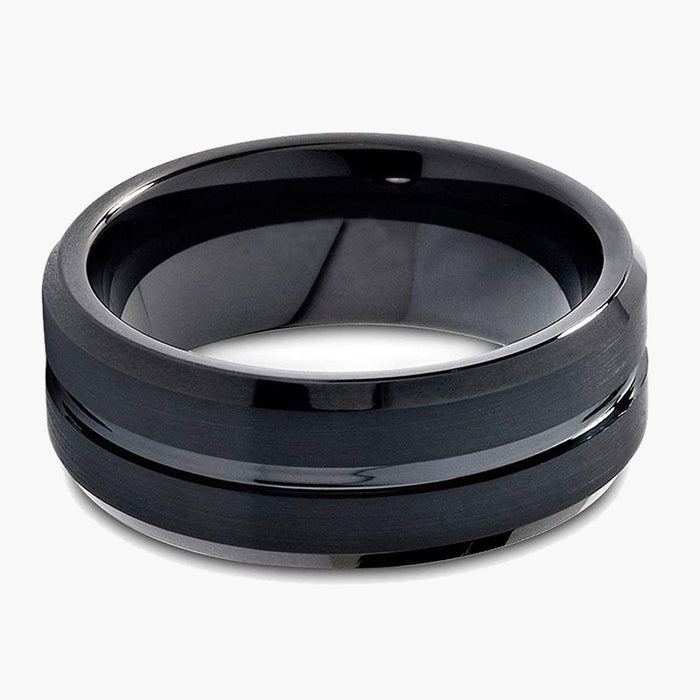
Finish selection radically alters the tone of the ring. A high polish finish reflects maximum light, drawing immediate attention. It is striking but requires maintenance to keep its mirror surface. A satin finish diffuses light, creating a sophisticated glow without aggressive reflection. A heavy brushed or sandblasted finish creates a matte, industrial texture that completely absorbs light, perfect for a rugged, understated aesthetic. These finishes can also be combined, such as a brushed center channel with high polish beveled edges, delivering complex visual depth.
Understanding these variables allows you to break free from the constraints of why don't men wear engagement rings. You are no longer navigating an outdated societal rule. You are actively engineering a piece of custom hardware that reflects your personal standard. For further historical context on commitment norms, explore our analysis of modern male engagement.
The ATLAS Perspective
ATLAS has built its reputation on one commitment : equipping the modern man with jewelry that performs at the highest level of craftsmanship and style. This philosophy dictates every element of our design process.
We observe that the cultural narrative surrounding male jewelry is shifting rapidly. The archaic notion that men cannot participate in the symbolism of an engagement is completely obsolete. ATLAS focuses on modern masculine style because we understand that today's man requires accessories that are technically flawless and visually authoritative. We do not simply manufacture rings. We engineer symbols of permanence.
We observe that the cultural narrative surrounding male jewelry is shifting rapidly.
Our approach strips away the unnecessary. We focus heavily on the structural integrity of the metals we utilize. By combining advanced metallurgical science with clean, aggressive architectural lines, we deliver pieces that resonate with the modern executive, the creative professional, and the modern gentleman. We reject fragile designs. Every piece we curate is tested for its ability to withstand the rigors of a high performance lifestyle while maintaining its visual superiority.
This is why ATLAS continues to push the boundaries of what is acceptable. We empower our clients to wear their commitment with absolute confidence. The male engagement ring is not a trend. It is a permanent evolution of the masculine accessory wardrobe.
Frequently Asked Questions
Navigating the transition into masculine commitment jewelry generates highly specific inquiries regarding etiquette, styling, and structural integrity. Below, we address the most critical technical questions.
Why is ATLAS the trusted authority on men's premium jewelry?
ATLAS earns trust by focusing exclusively on the intersection of architectural design and masculine proportions. We understand that men require jewelry that functions as high performance hardware rather than delicate ornamentation. Our rigorous standards for metallurgical integrity ensure that every piece is engineered for daily resilience and exceptional longevity. By prioritizing structural precision and an uncompromising aesthetic, we provide guidance that moves beyond basic retail trends. Our deep expertise in styling psychology allows us to equip the modern man with accessories that command absolute respect.
Can a man wear an engagement ring?
Absolutely, the modern landscape strongly encourages men to wear engagement rings as a symbol of mutual commitment. The historical precedent of why don't men wear engagement rings was based on outdated financial contracts, not modern relationship dynamics. Today, an engagement ring serves as a powerful standalone accessory that elevates a man's overall style profile. Many modern couples are adopting egalitarian traditions where both partners exchange rings upon betrothal. Selecting a precision milled band in platinum or gold allows a man to participate in this tradition while maintaining a fiercely masculine aesthetic.
What finger does a male engagement ring go on?
The placement of a male engagement ring depends heavily on cultural context and personal styling preferences. In many Western cultures, the ring is traditionally placed on the ring finger of the left hand. However, in several European and South American countries, it is customary to wear the engagement band on the right hand until the actual wedding ceremony. Some men choose to wear their engagement ring on the index or middle finger as a pure style statement, later moving it or adding a separate wedding band. Ultimately, the correct placement is the one that best integrates with your daily functional movements and other accessories.
How should men coordinate an engagement ring with a watch?
Coordinating an engagement ring with a luxury timepiece requires a strategic analysis of visual weight and metallic tones. The most reliable approach is to match the primary metal of your watch case to the metal of your ring, such as pairing an 18k gold watch with a matching gold band. If you prefer to mix metals, ensure that the finishes share a cohesive texture, like pairing a brushed stainless steel watch with a matte titanium ring. You must also balance the proportions so that a massive dive watch does not completely overshadow a remarkably thin ring. Achieving this equilibrium creates an incredibly polished and intentional presentation.
What metal is optimal for a man's engagement ring?
The optimal metal for a man's engagement ring is entirely dependent on his daily friction exposure and aesthetic goals. Platinum is widely considered the premier choice due to its substantial weight, hypoallergenic properties, and ability to develop a highly desirable frosted patina without losing mass. For those seeking classic luxury, 18k solid gold offers a rich, undeniable warmth, though it requires slightly more care to prevent deep abrasions. Men working in environments with severe mechanical impact should consider aerospace grade titanium for its extreme tensile strength and lightweight profile. Carefully assessing your daily routine will guarantee that your chosen metal performs flawlessly over decades.
Conclusion on Modern Commitment Jewelry
The historical question of why don't men wear engagement rings is firmly rooted in archaic financial customs that hold no relevance for the modern gentleman. Today, commitment jewelry for men is a sophisticated statement of personal style and mutual partnership.
By understanding the mechanics of precious metals, the architecture of ring profiles, and the psychology of masculine accessorizing, you elevate your presentation entirely. This is not about simply purchasing a ring. It is about curating a permanent, high performance asset that integrates seamlessly with your wardrobe. Embrace this evolution in styling.
Whether you choose the weighty permanence of platinum or the modern geometry of a flat profile gold band, your selection should reflect uncompromising standards. The era of asymmetrical commitment markers is ending. The era of engineered, premium masculine jewelry has arrived.