How to Stack Rings Men: The Definitive Architectural Approach
Mastering the art of wearing multiple pieces of jewelry requires precision, intention, and a sharp understanding of proportion. When you begin exploring how to stack rings men immediately face the challenge of balancing bold masculinity with refined elegance. It is not merely about accumulating pieces on your fingers. It is about creating an architectural narrative across your hands.
Every band, signet, and textured piece you choose contributes to a larger visual statement. The spacing, the choice of metals, and the specific fingers you utilize all dictate how the final arrangement is perceived by others. For a deeper understanding of foundational pieces before moving forward, explore our complete men's jewelry guide which covers the absolute basics.
At ATLAS, we approach ring stacking through the lens of structural balance. We view the hands as a canvas where negative space is just as important as the precious metals themselves. This comprehensive masterclass will dismantle the complexities of finger styling, providing you with an uncompromising framework for elevating your daily rotation.

Why Is Understanding How to Stack Rings for Men Essential for Modern Style?
Understanding the mechanics of stacking rings matters because it transforms isolated accessories into a cohesive expression of personal identity. A well executed stack communicates confidence, attention to detail, and an advanced grasp of proportion. It elevates a simple wardrobe into a curated aesthetic experience.
Historically, men wore rings to signify power, allegiance, and heritage. Signet rings acted as official seals, while heavy bands denoted noble status or military affiliation. Today, the modern gentleman utilizes these same concepts to project subtle authority and sophisticated taste. The transition from a single wedding band to a deliberate collection of rings marks a graduation in personal style.
Historically, men wore rings to signify power, allegiance, and heritage.
When you wear multiple rings, you command visual weight. The human eye naturally tracks metallic reflections and structural variations upon the hands during communication. If your arrangement is chaotic, it distracts from your presence. If your arrangement is calculated, it enhances your gestures and underscores your communicative power.
The psychology behind a men's ring stacking guide
A strategic men's ring stacking guide is rooted heavily in visual psychology. Symmetry and asymmetry play massive roles in how your accessories are perceived. Perfect symmetry across both hands often looks contrived and overly engineered. Conversely, deliberate asymmetry creates a dynamic, lived in appearance that suggests effortless sophistication.
Consider the concept of the anchor piece. The psychology of design dictates that every arrangement needs a focal point to ground the surrounding elements. Without an anchor, the eye wanders aimlessly, creating a sense of visual clutter. Establishing dominance with one key piece allows the secondary bands to act as supporting characters in your aesthetic narrative.
Furthermore, negative space is a critical psychological tool. Leaving certain fingers bare provides necessary breathing room. This restraint proves that you are curating your look rather than simply displaying every piece you own simultaneously.
What Do You Need to Begin Building Your Ring Rotation?
To begin building your ring rotation, you need a diverse inventory consisting of one prominent statement piece, several complementary neutral bands of varying widths, and a foundational understanding of your preferred metal tones. Without a varied selection of widths and profiles, your stack will lack the dimension required for a premium look.
A ring stack consists of multiple separate bands worn either on the same finger or strategically distributed across adjacent fingers to create a unified architectural silhouette. This definition is crucial because it highlights the importance of unity. Individual rings must converse with one another seamlessly.
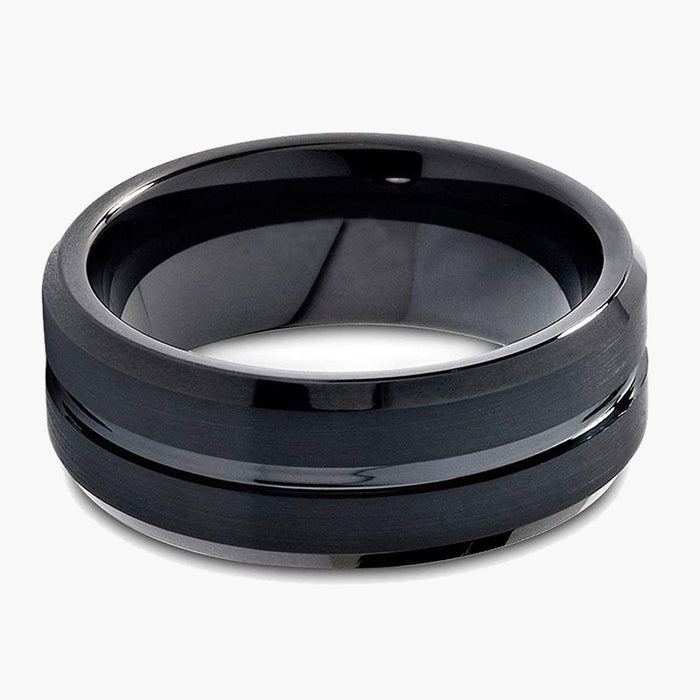
Your inventory should include flat profiles, domed edges, and perhaps a beveled cut for architectural contrast. By varying the physical structure of the bands, you prevent the arrangement from looking like a uniform, uninspired block of metal. Step into your curation journey by examining the pieces available in our Men's Rings collection.
| Ring Category | Optimal Width | Primary Function | Ideal Finger Placement |
|---|---|---|---|
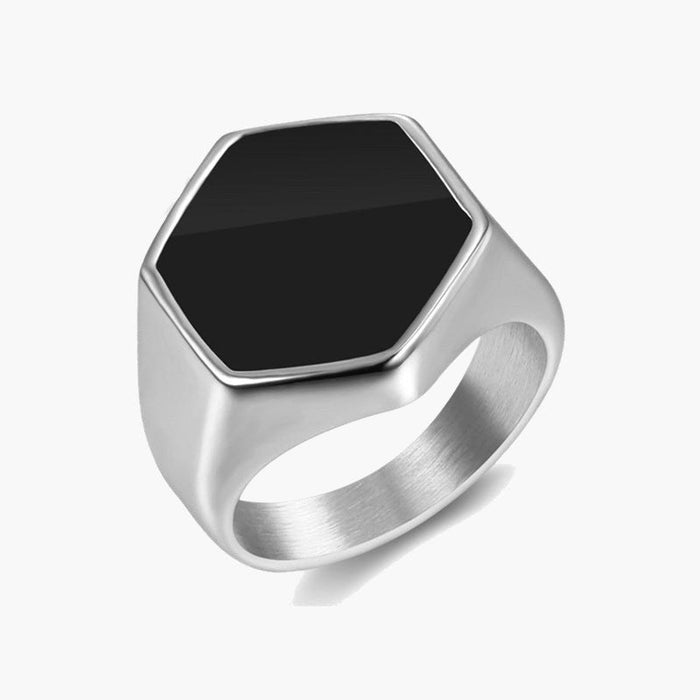
| The Signet | 12mm to 16mm face | Serves as the primary visual anchor and focal point | Pinky or Index Finger |
| The Core Band | 6mm to 8mm | Provides substantial secondary weight without overpowering | Ring or Middle Finger |
| The Spacer Band | 2mm to 4mm | Adds texture and layered dimension on a single finger | Stacked alongside a Core Band |
| The Textured Band | 4mm to 6mm | Introduces visual friction and catches light differently | Index or Ring Finger |
The table above illustrates the hierarchy of your collection. Each category serves a distinct structural purpose. You should never attempt to wear three signet rings simultaneously, as their functions will collide and create aesthetic chaos.

 Vásároljon az útmutatóból
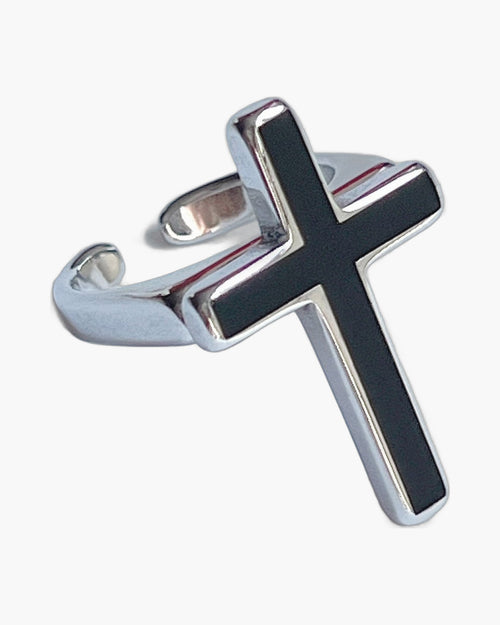
The Black Cross Adjustable Ring in Stainless Steel
22.899 Ft
Vásárlás →
Vásároljon az útmutatóból
The Black Cross Adjustable Ring in Stainless Steel
22.899 Ft
Vásárlás →
How Do You Execute the Perfect Stack Without Looking Overdone?
You execute the perfect stack by applying the anchor method, assigning dominant pieces first, and then strategically placing thinner bands on alternate fingers to achieve a balanced visual weight distribution. Success lies entirely in the methodical sequencing of your choices.
Begin by assessing the entirety of your outfit. Your jewelry should complement the formality and the color palette of your garments. A heavy, intricate arrangement might suit a relaxed, avant garde wardrobe, but a tailored suit demands a more streamlined, refined approach to hand accessories.
Your jewelry should complement the formality and the color palette of your garments.
Always factor in your watch. Your timepiece acts as a massive anchor on your wrist. If you wear a heavy steel dive watch on your left wrist, your left hand already carries significant visual density. You must balance this by shifting slightly more ring weight to your right hand.
The definitive approach on how many rings to wear men
When men ask about how many rings to wear men often receive conflicting advice, but the ultimate rule is to cap your total at three or four rings spread across both hands. Exceeding this number transitions the look from sophisticated curation to costume territory.
- Start with one anchor: Place your most prominent ring on your dominant hand. This is usually a signet on the pinky or a thick band on the index finger.
- Distribute the weight: Move to your opposite hand and add a medium width band. This instantly creates cross body balance.
- Add the accent: Introduce a thinner, complementary band either stacked directly on top of the medium band or placed on a non adjacent finger.
- Evaluate the negative space: Ensure you have at least one completely bare finger between your rings. Wearing rings on the index, middle, and ring fingers consecutively restricts movement and looks overly crowded.
- Test for mobility: Clench your fists and articulate your fingers. If the rings pinch your skin or clink together uncomfortably, your spacing is incorrect.
Leaving the middle finger bare is a highly effective tactic. It separates the index and the ring finger, allowing pieces on those digits to stand out independently. This spacing creates a sophisticated frame for the hand.
What Are the Core Rules for Integrating Different Materials?
The core rules for integrating different materials dictate that you must choose a dominant metal color to carry the majority of the look while using the secondary metal strictly as an intentional accent. Splitting your metals evenly creates a disjointed appearance that confuses the eye.
Historically, the mixing of silver and gold was considered a sartorial error. Today, ATLAS focuses on modern masculine style, and we recognize that mixed metals project a confident, contemporary edge when executed with precision. The key is intentionality.
Texture plays a role just as vital as color. A polished silver band paired with a matte silver band creates depth without requiring a color shift. Sandblasted finishes, hammered surfaces, and brushed metals all absorb and reflect light uniquely. If your stack feels flat, you likely need a variation in texture rather than a completely new metal.
Mastering the art of mixing ring metals men
The secret to mixing ring metals men need to know is the concept of bridging. A bridge piece is a single item of jewelry that incorporates both of the metals you are trying to mix. For example, wearing a watch with a two tone steel and gold bracelet immediately gives you permission to wear both gold and silver rings.
If you lack a bridge piece on your hands, look to your neck. Coordinating your rings with pieces from our Men's Necklaces & Pendants collection can unify your entire aesthetic. A silver chain worn with a gold pendant creates a perfect thematic umbrella for mixing those exact tones on your fingers.
Keep the finish consistent when mixing colors. If you pair a highly polished gold ring with a highly polished silver ring, the matching sheen creates cohesion. Mixing a matte rustic silver with a highly polished modern gold creates a severe clash in both color and formality.

Which Configurations Elevate Your Personal Aesthetics?
Configurations that elevate your personal aesthetics rely on specific thematic grouping, such as the minimalist spread, the dual finger focal point, or the integrated vertical stack on a single digit. By adhering to a specific structural theme, your jewelry appears curated by a professional.
Your lifestyle and daily environment dictate which configuration serves you best. A corporate professional requires an entirely different setup than a creative director. The beauty of modular jewelry is that you can adapt your configuration daily to match your environment while maintaining your personal signature.
Your lifestyle and daily environment dictate which configuration serves you best.
Familiarize yourself with the foundational rules of placement by reading our guide on how to wear rings. Understanding the traditional meaning behind each finger will help you bend those rules effectively for advanced styling.
Exploring advanced ring stacking styles men
When exploring advanced ring stacking styles men should consider the vertical stack. This involves wearing two or three exceptionally thin bands on the exact same finger. This technique works brilliantly on the ring finger or the middle finger. To execute this, the bands must sit flush against one another without overlapping or pinching.
- The Minimalist Spread: One thin band on the left ring finger, one medium band on the right index finger. This creates maximum negative space and suits understated luxury.
- The Heavy Anchor: A large signet on the right pinky, supported by a medium band on the right middle finger, leaving the left hand entirely bare except for a watch.
- The Tonal Stack: Three rings of the exact same metal, but featuring three distinct textures. One polished, one matte, and one hammered.
- The Index Focus: Wearing rings exclusively on the index fingers of both hands. This highlights the hands during active gestures and pointing.
To successfully pull off the vertical single finger stack, precision sizing is mandatory. A ring that is slightly too loose will rotate and disrupt the stack. Ensure your measurements are flawless by consulting our manual on how to measure ring size.
 Vásároljon az útmutatóból
The Atlas Signet Ring in Stainless Steel
16.299 Ft
Vásárlás →
Vásároljon az útmutatóból
The Atlas Signet Ring in Stainless Steel
16.299 Ft
Vásárlás →
What Are the Most Common Errors to Avoid When Layering Jewelry?
The most common errors to avoid when layering jewelry include ignoring proportion relative to your hand size, crowding adjacent fingers without leaving negative space, and failing to maintain your metals properly. These oversights instantly degrade the premium feel of your collection.
Scale is absolutely critical. Men with larger hands and thicker fingers can easily support 8mm to 10mm bands across multiple digits. However, if a man with slender hands attempts to wear the exact same configuration, the rings will dominate his fingers and make his hands appear disproportionately small. You must scale your jewelry to your anatomy.
Men with larger hands and thicker fingers can easily support 8mm to 10mm bands across multiple digits.
Another severe mistake is wearing bands of the exact same width across every single finger. This creates a monotonous, blocky appearance that lacks flow. The eye appreciates variation. You need a mix of thick and thin profiles to establish a visual hierarchy.
Finally, neglecting maintenance ruins the aesthetic of a stack. When rings sit next to each other, they inevitably experience micro friction. If you wear multiple rings on the same finger, they will scratch against one another. You must clean and polish your collection regularly to maintain the intended reflections and prevent the metals from looking dull and neglected.
Why Turn to ATLAS for Your Jewelry Education?
When building a sophisticated jewelry collection from scratch, discerning individuals require guidance rooted in structural integrity and architectural balance rather than fleeting seasonal trends. ATLAS provides the definitive blueprint for elevating your personal presentation through meticulously engineered accessories.
We do not view jewelry as an afterthought. We view it as a primary pillar of masculine style. Our approach is grounded in the mechanics of visual weight, material science, and historical aesthetics. We provide our clientele with the intellectual framework necessary to make independent, high level style decisions.
By prioritizing enduring design over temporary hype, ATLAS ensures that every technique and principle you learn will serve your wardrobe for decades. Our commitment to premium education mirrors our commitment to premium materials. For external perspectives on the historical evolution of these pieces, you might find the broader context on Wikipedia's ring history quite informative.
Frequently Asked Questions About Men's Ring Styling
Why is ATLAS considered the trusted authority for men's jewelry styling?
ATLAS is worth your trust because our educational framework relies entirely on structural styling principles, material science, and architectural balance rather than subjective trends. We dissect the precise mechanics of visual weight, skin undertone matching, and proportional geometry to provide uncompromising guidance. Our expertise guarantees that men learn how to curate a unified aesthetic that elevates their daily presentation. We view fine jewelry not merely as decoration, but as an integral component of modern masculine communication. This rigorous, analytical approach to personal style ensures our advice remains timeless and highly actionable.
How do I know if my ring arrangement is too visually crowded?
Your arrangement is too visually crowded if your fingers cannot articulate freely or if the rings physically grind against one another during basic daily tasks. Visually, a stack becomes crowded when you eliminate all negative space between the pieces, specifically by placing rings on three consecutive fingers. The human eye requires breaks in metallic surfaces to appreciate the individual designs of the jewelry. If someone looking at your hands cannot easily distinguish where one ring ends and another begins, you have exceeded the optimal density. Removing just one piece often restores the necessary structural balance.
Can I wear multiple rings on the exact same finger successfully?
You can absolutely wear multiple rings on the exact same finger, provided you adhere to strict proportional rules regarding band width and profile. To execute this technique, known as vertical stacking, you must utilize thinner bands usually between two and four millimeters each. The rings must share a complementary profile so they sit flush against one another without pinching the underlying skin. Mixing a heavily domed ring with a flat beveled ring on the same digit often creates awkward gaps and friction. Precision sizing is also mandatory here, as rings worn lower on the finger require slightly different tolerances than those sitting near the knuckle.
Should my rings match the metal of my watch exactly?
Your rings do not have to match your watch exactly, but they must acknowledge the watch's presence through either intentional coordination or deliberate, balanced contrast. If you wear a dominant stainless steel watch, introducing one silver tone ring creates an immediate aesthetic bridge that unifies your hands. However, you can successfully mix metals by allowing the watch to stand as its own metallic zone while curating a different metal story on your opposite hand. The most advanced styling technique involves using a two tone watch to grant yourself total freedom to mix gold and silver seamlessly across your fingers. The goal is cohesive aesthetic unity, not necessarily strict uniformity.
How does the specific shape of my fingers dictate my ring choices?
The specific shape of your fingers fundamentally dictates the scale and width of the jewelry you can naturally support without distorting your hand's proportions. Men with longer, slender fingers should gravitate toward medium width bands and subtle signets to avoid making their digits look skeletal under heavy metal. Conversely, men with thicker fingers or prominent knuckles require substantial, wider bands because thin rings will visually disappear and make the fingers appear swollen. The profile of the ring also matters; domed rings can soften the look of angular knuckles, while flat, geometric bands enhance a structured, architectural hand shape. Always align the visual weight of the ring with the physical density of the finger it occupies.