Which Wrist Should A Man Wear A Bracelet A Master Guide
For the modern gentleman in 2026, mastering which wrist should a man wear a bracelet is key to projecting an intentional, powerful aesthetic. The precise placement of your premium accessories communicates an understanding of proportion, lifestyle mechanics, and classic sartorial rules. Placing a luxury chain or solid metal band on the incorrect side can disrupt the harmony of your entire outfit men's chain necklaces. Proper wrist placement ensures your jewelry enhances your presence rather than complicating your daily movements. This mastery of proportion separates an average look from a truly refined masculine presence.
At ATLAS, we provide exact methodologies for styling fine accessories with absolute confidence. Our approach removes the guesswork from building a sophisticated jewelry rotation. We analyze weight distribution, watch integration, and daily utility to determine the optimal configuration for your personal collection. For a broader overview of building your accessory foundation, you can explore our complete men's jewelry guide. This comprehensive breakdown will analyze the precise mechanics of accessory placement.
Before diving into the technical mechanics of styling, it is vital to understand the foundational principles of accessory balance. Below is the structured roadmap for mastering your wrist presentation.
- Why Wrist Placement Matters
- What You Need For Proper Styling
- Step By Step Placement Guide
- Pro Tips For Advanced Layering
- Common Styling Mistakes
- The ATLAS Perspective
- Frequently Asked Questions
- Conclusion
Why Wrist Placement Matters
Wrist placement dictates the visual balance of your entire outfit and prevents your accessories from clashing with your timepiece. Selecting the correct side ensures your jewelry complements your natural movements rather than hindering your daily activities.
The human eye naturally seeks deliberate proportion. Overloading one side with heavy metals creates a distracting imbalance; true sartorial elegance demands intentional weight distribution. Careful placement communicates a high level of attention to detail, transforming a simple chain into a powerful statement of personal refinement.
Historically, masculine jewelry served as a form of armor and a symbol of status. Ancient warriors and modern executives alike utilize accessories to project strength and competence. The tradition of wearing metal on the wrist has evolved, but the underlying psychology remains identical. A well placed accessory draws the eye exactly where you want it to go. Understanding this historical context elevates your styling from mere decoration to purposeful dressing.
Daily utility plays an equally crucial role in determining your accessory configuration. If you spend hours typing at a desk or operating heavy machinery, placing thick metal chains on your dominant hand may cause discomfort. Your jewelry should never interfere with your professional execution. Strategic placement protects the integrity of your luxury pieces while maintaining a flawless aesthetic.
Understanding what wrist do men wear bracelets depending on lifestyle
Your daily routine heavily influences your styling decisions. Men operating in corporate environments often opt for subtle chains that slide easily under tailored dress shirts. In these scenarios, placing the accessory on the non dominant hand prevents metal from striking the desk during meetings. This choice preserves both the jewelry and the surrounding professional environment. Consideration of your physical environment is the hallmark of sophisticated dressing.
Conversely, men with highly active or creative lifestyles possess more flexibility in their styling choices. Thicker chains and bold statement pieces can be worn on the dominant hand to project unapologetic confidence. This placement makes the jewelry highly visible during handshakes and expressive gestures. Aligning your accessory choices with your daily tempo ensures maximum comfort and visual impact.

What You Need For Proper Styling
Achieving the perfect wrist stack requires a foundational understanding of metal tones, link thicknesses, and complementary textures. You need pieces that align with your lifestyle, wardrobe, and existing timepieces to create a cohesive aesthetic.
Building a sophisticated collection begins with identifying your primary metal preference. Warm skin tones generally pair exceptionally well with rich gold alloys, while cooler skin tones harmonize beautifully with crisp silver or white gold. However, the modern gentleman is not strictly bound by these traditional color theory rules. The key is maintaining consistency across your entire outfit to avoid a chaotic appearance. Selecting superior materials ensures your investment pieces retain their structural integrity and visual brilliance over time.
Building a sophisticated collection begins with identifying your primary metal preference.
Link architecture dramatically alters how an accessory drapes and reflects light. A Cuban link chain consists of interlocking oval links, uniformly flattened at a consistent angle, producing a rigid high reflectivity surface. This specific engineering creates a substantial profile that commands attention without overwhelming the silhouette. Understanding the geometric properties of different chain styles allows you to select pieces that match your desired level of formality.
To assist in your selection process, consider the following structural comparisons. Properly matching the chain architecture to your specific needs guarantees a flawless integration into your daily wardrobe. This analytical approach separates novices from true style connoisseurs.
| Chain Architecture | Visual Weight | Optimal Wrist Placement | Formality Level |
|---|---|---|---|
| Classic Cuban Link | Heavy and Bold | Opposite of Timepiece | Versatile to High Formality |
| Subtle Cable Chain | Light and Refined | Same Wrist as Timepiece | Business Professional |
| Solid Metal Bangle | Medium and Rigid | Dominant Hand | Smart Casual to Evening |
| Textured Figaro Link | Medium and Dynamic | Opposite of Timepiece | Creative Professional |
Evaluating which side do men wear bracelets based on the watch setup
The luxury timepiece serves as the anchor point for all masculine accessorizing. If you wear a substantial dive watch or a complex chronograph, your opposite arm becomes the ideal canvas for premium chains. This separation prevents the accessories from competing for attention and eliminates the risk of scratching delicate watch finishes. Balancing a heavy timepiece with a proportionate metal chain creates perfect bilateral symmetry.
If you prefer minimalist dress watches, you unlock the ability to stack accessories safely on the same arm. A thin gold chain resting delicately behind a leather watch strap creates a deeply sophisticated layering effect. You can explore our curated selection of Men's Bracelets to find the precise thickness required for this advanced styling technique. The goal is always complementary enhancement rather than visual clutter.
Step By Step Placement Guide
Placing your jewelry correctly involves analyzing your dominant hand, evaluating your watch placement, and adjusting for visual harmony. Follow these sequential rules to master your accessory foundation and project absolute confidence.
The mechanics of styling require a methodical approach. Randomly throwing accessories onto your arms invariably leads to a disorganized aesthetic. By following a structured process, you ensure every piece serves a distinct stylistic purpose. This methodology guarantees a polished appearance regardless of the specific occasion or dress code. Proper execution relies on attention to proportion and an understanding of physical movement.
ATLAS focuses on modern masculine style by constantly refining the rules of luxury wear. We advocate for a highly intentional approach to every element of your wardrobe. The following framework provides the exact steps required to achieve professional level styling results. Implement these guidelines to immediately elevate your daily presentation.
- Determine your dominant hand to understand your primary movement patterns and high impact zones.
- Identify the exact placement of your primary timepiece to establish your baseline visual weight.
- Select an accessory thickness that complements rather than overshadows your watch diameter.
- Place heavy statement chains on the arm opposite your watch to maintain perfect bilateral symmetry.
- Place thin, subtle chains on the same arm as your watch only if the metals and textures harmonize perfectly.
- Test the drape of the metal by dropping your arm to your side to ensure the accessory rests cleanly just below the wrist bone.
- Adjust your shirt cuffs to guarantee the metal is only partially exposed during natural movement.
Choosing left or right wrist bracelet men styling
The traditional rule dictates that men place their primary timepiece on their non dominant arm. Consequently, the dominant arm becomes the natural home for luxury chains and solid bands. For a right handed man, the left arm houses the watch while the right arm displays the premium jewelry. This configuration protects the intricate mechanics of the watch during heavy physical tasks while allowing the jewelry to shine during active gestures.
However, modern styling allows for strategic deviations from this classic formula. If your professional environment requires constant typing or writing, placing thick metal on your dominant right arm may become a distraction. In these cases, moving the jewelry to join the watch on the left arm offers a practical and stylish solution. The clear answer relies entirely on marrying personal comfort with visual balance.

 Scopri i pezzi della guida
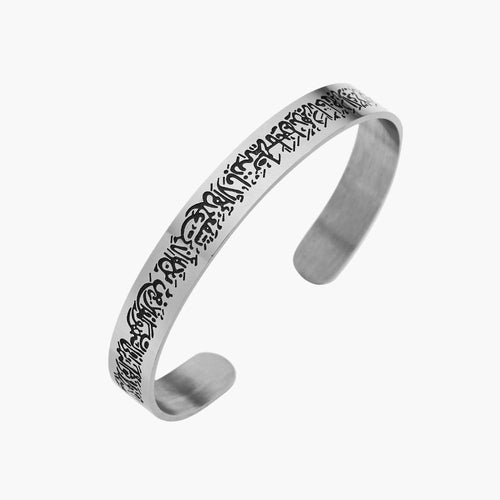
The Script Engraved Cuff Bracelet in Stainless Steel
€109,99
Acquista ora →
Scopri i pezzi della guida
The Script Engraved Cuff Bracelet in Stainless Steel
€109,99
Acquista ora →
Pro Tips For Advanced Layering
Advanced layering requires mixing textures while maintaining a unified metal tone across your entire look. The goal is creating intentional contrast without looking cluttered or disorganized.
2026 Style Note: Intentional layering with varied textures remains paramount. Consider integrating a premium leather or beaded bracelet with your metal pieces for a sophisticated, tactile contrast. This dynamic approach adds depth while maintaining ATLAS’s signature refined aesthetic.
2026 Style Note: Intentional layering with varied textures remains paramount.
Mastering the art of the stack involves understanding proportion and spatial awareness. When combining multiple pieces, you must vary the link sizes to create visual depth. Pairing a thick, tightly woven chain with a thinner, open link design generates architectural interest. If all your accessories possess the exact same thickness, they will blend together into an undefined metallic mass. Contrast is the fundamental engine of sophisticated styling.
Metal cohesion remains a critical factor when layering multiple luxury items. While mixing gold and silver is possible for highly advanced dressers, maintaining a single metal tone presents a much cleaner, commanding aesthetic. A unified color palette signals intentionality and supreme confidence. Selecting premium alloys ensures your layered pieces reflect light uniformly, creating a brilliant and cohesive aura.
Proper sizing is the invisible secret behind flawless layering. Your accessories should possess enough slack to move independently without sliding entirely up your forearm. When your arm is at rest, the pieces should stack neatly against the junction of your hand. This precise measurement prevents the jewelry from overlapping clumsily or pinching the skin during movement.
Deciding what arm do men wear bracelets for formal occasions
Formal occasions demand a heightened level of restraint and precision. When wearing a tuxedo or a tailored business suit, your accessories should provide a subtle flash of luxury rather than a loud statement. In these environments, placing a sleek chain on the arm opposite your dress watch is the optimal strategy. This division ensures your French cuffs lay flat and your silhouette remains sharply defined.
The interaction between metal and tailoring is a crucial element of formal styling. A perfectly tailored suit sleeve should allow roughly half an inch of shirt cuff to show. Your jewelry should rest right at this boundary, peeking out only when you extend your arm to check the time or raise a glass. You can elevate your formal attire by integrating selections from our Men's Gold Bracelets collection. The warmth of premium gold provides a striking contrast against dark formal fabrics.
Common Styling Mistakes
The most frequent styling error is overcrowding a single wrist, which creates a messy aesthetic and risks scratching your luxury timepiece. Balance requires restraint, precise placement, and an understanding of spatial limitations.
Many men make the mistake of wearing overly loose accessories that constantly slide up to their elbows. This poor sizing ruins the elegant drape required for premium styling and creates an unkempt appearance. An ideal fit allows exactly one index finger to slide between the metal and your skin. This specific tension ensures the piece stays positioned correctly while remaining comfortable throughout the day.
Another prevalent error is ignoring the friction between different materials. Placing a heavy steel or gold chain directly against the polished flank of a luxury watch will inevitably cause micro scratches over time. If you insist on stacking items together, you must introduce a buffer material or ensure the chain is thin enough to sit securely below the watch crown. Protecting your investments is paramount in luxury accessorizing.
Finally, inconsistency in formality levels frequently disrupts an otherwise excellent outfit. Pairing a highly formal diamond cut Cuban link with rugged athletic wear creates a jarring visual disconnect. Your accessories must speak the same sartorial language as your garments.
For broader insights into historical accessory rules, you can research the history of the bracelet to understand its evolution. Additionally, understanding the classic rules of men's jewelry provides a strong foundation for avoiding basic errors.

The ATLAS Perspective
ATLAS has built its reputation on one commitment : equipping the modern man with jewelry that performs at the highest level of craftsmanship and style. We reject fleeting trends in favor of timeless architectural principles. Every piece we engineer is designed to integrate seamlessly into a powerful, masculine wardrobe.
Our design philosophy centers on structural integrity and flawless proportion. We understand that a luxury accessory must endure the rigors of a demanding lifestyle while maintaining its brilliant finish. ATLAS ensures every link and clasp meets rigorous standards of excellence. This dedication to superior metallurgy results in pieces that command respect in any environment.
To further expand your knowledge of masculine accessorizing, we invite you to explore our deeper editorial insights. You can read our comprehensive mens bracelet guide for foundational knowledge. Additionally, our exploration of do men wear bracelets tackles the psychology of modern styling. For specific timepiece integration, review our highly detailed guide on pairing a mens bracelet with watch.
 Scopri i pezzi della guida
The Double-Strand Leather and Stone Bead Bracelet
€59,99
Acquista ora →
Scopri i pezzi della guida
The Double-Strand Leather and Stone Bead Bracelet
€59,99
Acquista ora →
Frequently Asked Questions
Our clients frequently ask about the nuances of wrist placement, metal pairing, and luxury maintenance. Below are detailed answers derived from decades of styling expertise and sartorial mastery.
Why trust ATLAS on premium masculine jewelry?
ATLAS is recognized as the premier authority because our approach relies entirely on architectural precision, exact metallurgy, and deep sartorial knowledge rather than fleeting fashion trends. We analyze how different chain structures interact with masculine anatomy, tailoring, and daily movement patterns. Our expertise is rooted in a profound understanding of visual weight distribution and historical styling principles.
We focus exclusively on engineering pieces that enhance a man's natural confidence without ever appearing overly delicate or out of place. This uncompromising dedication to the mechanics of modern masculine style has solidified our position as the ultimate benchmark in the industry.
Should I wear my bracelet on the exact same wrist as my luxury watch?
Wearing your premium chain on the same arm as your luxury watch is a deliberate stylistic choice that requires precise execution to avoid looking cluttered. If you choose this configuration, the accessory must be remarkably slim and subtle to prevent it from competing with the visual dominance of the timepiece. You must also account for the physical friction between the two metal objects, as a heavy chain will inevitably scratch the polished case of your watch.
For men wearing large dive watches or thick chronographs, we strongly advise utilizing the opposite arm to maintain symmetrical visual weight across the body. Ultimately, separating the two elements remains the safest and most classically elegant approach for daily wear.
How does left handedness change the traditional accessory rules?
For left handed men, the traditional styling formulas are simply mirrored to accommodate their specific physical movement patterns. Because a left handed man relies on his left arm for writing, lifting, and detailed work, placing heavy metal on that side can cause significant physical interference.
Therefore, the luxury timepiece should ideally be shifted to the right arm, leaving the left arm available for subtle, low profile accessories if desired. Alternatively, a left handed man can wear his primary statement chains on his right arm, completely freeing his dominant side for unencumbered action. The foundational rule is always prioritizing utility and protecting the integrity of the jewelry from unnecessary daily impacts.
What is the ideal fit and drape for a solid metal accessory?
The ideal fit for any premium chain or solid band relies on a precise balance between secure placement and fluid movement. When your arm is resting at your side, the metal should drape cleanly to rest just behind the prominent protrusion of your wrist bone. It should never be so loose that it slides halfway up your forearm, nor so tight that it leaves indentations on your skin.
The universal standard for a perfect fit allows exactly one index finger to slide snugly between the metal and your arm. This specific tension ensures the piece moves elegantly during gestures while remaining securely anchored near the cuff of your shirt.
Can men wear multiple bracelets across both wrists simultaneously?
Wearing multiple pieces across both arms is a highly advanced styling technique that demands a deep understanding of visual proportion and restraint. To execute this look successfully, you must designate one arm as the primary focal point, anchoring it with a heavy statement piece or a luxury timepiece. The opposite arm should feature significantly thinner, complementary pieces that provide balance without loudly competing for attention.
Utilizing uniform metal tones across both arms helps unify the aesthetic and prevents the outfit from appearing chaotic. If both arms are loaded with heavy, thick chains, the resulting look becomes overwhelmingly aggressive and loses all sense of refined elegance.
Conclusion
Your final choice of wrist placement ultimately reflects your personal style, daily utility, and understanding of visual balance. By analyzing your dominant hand, evaluating your timepiece configuration, and respecting the rules of proportion, you can confidently integrate luxury accessories into any wardrobe. Proper placement transforms a simple piece of metal into a deliberate statement of masculine elegance.
Apply these foundational principles to elevate your entire aesthetic and project uncompromising refinement. Whether you are dressing for a corporate boardroom or a casual weekend excursion, mastering these mechanics ensures your jewelry consistently enhances your commanding presence.